Architecture

Architecture, civil engineering, and planning are the means by which we design our environments. The environments created are there to perform a function: aesthetic perhaps, but also, and chiefly, practical: the designed environments are there to facilitate some of our life activities. Inevitably, such designs entail compromises to manage costs, materials, pollutants and local norms and regulation. These compromises may mean not everyone benefits from the designs; some may even be hampered.

These designs, as much as they may enhance our lives, also control them. Roads in particular have strictly enforced norms governing behaviour. There is nothing in principle stopping you from driving the wrong way up a dual carriageway; from time to time people do (though rarely do they do so deliberately). However, they tend to gain little from the enterprise, even if they manage to avoid an accident or retribution from the law. Urban environments are also heavily controlled and monitored. Walls and barriers channel pedestrians; signs tell them to keep left, walk or don’t walk, to keep out, or that the mall closes at 10pm. The predominance of private property in urban environments further constrains freedom. Designed environments can be perfected with greater financial investment. Thus, the more money a society has to design its environments and to implement those designs, the more control it can exert over its individuals.
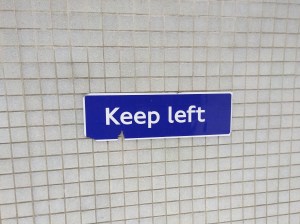
IMG_20190323_082147

With control comes homogenization and loss of individuality. The environments are designed around the ‘average’ person: the more average you are, the more convenient you will find them. Everything from homes to shops to entertainment to workplaces become designed for the average person. As you deviate from the norm, you increasingly find the world is not for you. If the environment is selective, those at the extremes of the bell-curve will be eliminated or forced to move elsewhere.

Separately, globalization is leading to homogenization of environments, meaning that there are fewer and fewer ‘refuges’ for those who do not conform to the norm. If life is easier and more convenient in designed environments, then standard evolutionary theory would have us believe that this leads to an explosion of diversity in the population. But when society itself is part of that designed environment, norm enforcement acts to oppose this process. People are arrested for “looking suspicious” or “behaving suspiciously“.

Contrast rural environments. Though there are codes of behaviour (such as the ‘country code‘), the law is weighted more in favour of freedom of access (albeit sometimes to the chagrin of landowners). Even in farmland, ramblers enforce access rights where landowners try to close them off. Many humans, then, hold dear the idea of freedom to roam in natural (or at least, non-urban) environments, whilst cheerfully accepting considerable constraints on and monitoring of their behaviour in cities. Though the fact that farmland is a designed environment detracts from the argument somewhat, freedom is associated with non-designed environments, while control is associated with designed environments.

Nature may impose constraints on access in the wilderness. Marshes, rivers, mountain ranges, oceans, deserts, ice sheets, gullies, dense forest, even the weather – all impede progress if you have a particular destination in mind, or a curiosity to satisfy. All can prove dangerous or even deadly. However, these constraints reward the brave, the inventive, the creative. They encourage thought, ingenuity and intelligence. The cost may be death, but the rewards could be access to new territory and new food sources, new people to meet and trade with. Designed environments offer no incentives, no rewards for ‘breaking the rules’: they encourage only docility and compliance. What is to be gained from going up a ‘down’ escalator?

Of course, it is the aversion of risk that leads us to enhance our environments by designing them to make access easier. We now cross marshes daily at high-speed without worrying about falling ill, getting lost, or stuck in quicksand, thanks in part at least to the ingenuity of our ancestors who built railways, paths and roads across them. We have put bridges across the Firth of Forth, and tunnels under the Channel and through the Alps. Once our whole planet is designed and subjugated in this way, our descendants will be left only with the task of maintenance (itself part of the design); there will be little need for the creativity that created the routes in the first place.

The human race of the future risks being completely homogenized, domesticated and cowed all in the name of convenience. This hominid, which might be dubbed Homo suburbiensis, has no creativity, no individuality, no knowledge of how to survive other than by earning money to spend at the supermarket. The only ray of ‘hope’ is in ‘natural disasters’. A ‘natural disaster’ is an event not directly caused by humans such as an earthquake or a flood, albeit that the latter could be caused by poor catchment ‘management’ or unseasonably high rainfall as a result of climate change. A natural disaster is a disaster from the point of view of maintaining convenient lifestyles, as well as from the point of view of those immediately injured or killed by the occurrence. Either perspective is a purely human one, and I confess to a somewhat cynical suspicion that the former rather than the latter (for those who are not friends or relatives of the dead) is what chiefly merits the label of ‘disaster’ to an event. Life ceases to be easy, and suddenly becomes a day-to-day struggle to find food, clean water and shelter, while avoiding disease. Meteor strikes, hurricanes, supervolcano eruptions, tsunamis, coronal ejections, supernovas, gamma ray bursts, black holes — the universe has a number of weapons in its armoury that can cause greater damage in the short and long term than anything humans can achieve. Where these obliterate our infrastructure, the slate is wiped clean, and if we want to rebuild everything, we will have to design it again.

Disasters occur on various scales of course. The larger the scale, the more difficult the recovery. But the scale of a disaster is also somehow subjective with respect to human population density and interdependence. The more coastal towns there are, the more likely it is that one will get flooded. The more people live near volcanos, the more people will be killed by them. The more interconnected we are, the more remote an event has to be before it has a reduced potential to affect us. Designed environments create fragility and vulnerability. The easier they make life for humans, the more humans they can sustain (even if not sustainably), and so the more humans are affected when the designed environments fail. Worse, where designed environments replace an ecosystem that we once knew how to live in, so that knowledge is lost. Then, when the system fails, no-one knows how to survive in what remains. Designed environments create designed humans, dependent entirely on designed systems to support their existence.
A pinch of salt

Ever since reading an opinion piece in the Guardian about Soylent, I have been intrigued by the possibility of experimenting with meal replacements as I thought the experience would be fascinating to look at from an ecocyborg manifesto perspective. It took several months (and the encouragement of a fellow hacker) to work up the courage to give it a try, though we ended up using Huel rather than Soylent because it’s available in the UK in powdered form. For £45, you got two bags of Huel, a shaker, a T-shirt and an instruction manual.

What is this stuff, and what’s it all about? I don’t know whether it’s true or not, but Huel strikes me as being a contraction of HUman fuEL, and it’s what you end up with when you regard food as something that is solely about nutrition to keep the body and brain functioning and generating value. I was particularly struck by the quotation of Rob Rhinehart’s (Soylent founder) deleted blog post in the Guardian opinion piece: “I think it was a bit presumptuous for the architect to assume I wanted a kitchen with my apartment and make me pay for it.” Quite. If the function of food is simply to keep you going, in much the same way electricity does a computer, or fossil fuels a car, then what the hell are you doing faffing around choosing recipes, chopping vegetables, making sauces, and inviting friends over for a meal? That’s time you could be earning money, spending it, or undertaking ‘lifestyle’ activities like free-sky-board-wave-bike-surfing or whatever it is that means you’ll need a crossover SUV, some form of lycra costume, and about £2,000 of kit.

Ironically, the ecocyborg is already putting pressure on you to drop food preparation; another comment piece in the Guardian suggested houses of the future won’t have kitchens. This is so that more and more of us can be crammed like cattle into compact megacities in the name of efficiency and sustainability. The message will, in time, become clear: eating food, rather than scientifically prepared just-add-water nutrient sachets will be seen as a bourgeois indulgence. How outrageously luxurious to be able to cook when you could be running another delivery or developing the next viral meme!

My main finding from trying Huel was that the only way I could get the stuff down without gagging was if I took it with a pinch of salt.

A riddle for materialists

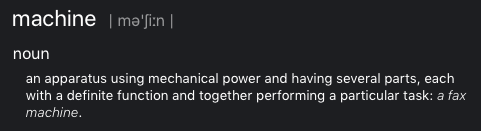
Screen shot of the definition of 'machine' from Apple's dictionary app on 9 February 2019. A machine is defined as: 'An apparatus using mechanical power and having several parts, each with a definite function and together performing a particular task.'

As scientists, we often look at humans and nature as though they are ‘systems‘. Our descriptions of what we observe are mechanistic: formal, mathematical and algorithmical. We don’t want to invoke concepts, very familiar in other endeavours, that we cannot observe and do not have evidence for, but I expect many of us are not entirely happy seeing ourselves, our friends and family, and the natural world, in purely mechanistic terms.

So, what is something if it is not a machine?

It is easy to confuse the fact that something can be described in mechanistic terms with the belief that the thing being described is a machine. So, just because my digestion, circulatory system, immune system, lymphatic system, musculoskeletal system, nervous system, etc. etc. can be described in purely mechanistic language as the function of interactions among cells, molecules, organs, bones and skin; and even though some of these things can be replaced by actual human-made machines (e.g. heart, kidney, artificial limbs) — I am not ‘just’ a machine. To describe me, you, anyone, and indeed the rest of nature itself, as a machine is, at an emotional level, not doing any of us justice.

How can I assert that I am not a machine without invoking the supernatural? Well, one way of handling that kind of argument is to muck around with the definition. I don’t think I need to do that too much, however (see the screen grab above), if I say that I think a machine is necessarily something that has been designed to perform a particular function. If that’s a reasonable definition, then, as it implies, all machines must have a designer. This messes with the brain a little: describing things as machines, something scientists do to avoid invoking the supernatural, fails precisely because so doing means there must be an intentional designer of some sort (intelligent or otherwise) who needs that function performed. I think it’s a bit weak to say we’ve been ‘designed’ by nature — then we might ask who (or what) designed nature. Besides, nature doesn’t ‘need’ the functions performed by humans — looking at various environmental disasters humans have caused (more than just recently), I often wonder whether, if Nature did have intentionality, she would consider herself better off without us. Be that as it may, it is funny to watch documentaries about biology and ecology and count the number of times the word ‘design’ is used by the narrator or presenter.

If you think about it, the absence of a designer who has a function or purpose for us that we must fulfil is liberating. When I first thought of this, I was somewhat unnerved. I had a Christian upbringing. The absence of any purpose felt worrisome, perhaps because it left responsibility for what I did, and did not, do squarely on my shoulders; rather than allowing myself to duck the responsibility and claim I am just fulfilling a deity’s plan for me (or following my genetic programming, or some hapless victim of my environment). Of course, it also meant I am insignificant — there isn’t a supreme ultimate being that is deeply interested in what I do. Many schools of thought end up ascribing some sort of purpose to our lives. Besides being ‘saved’ or becoming enlightened, or whatever your religion gives as your purpose, biologists tell you you must reproduce, capitalists that you must accumulate wealth, Marxists that you must be socially ‘active’, academics that you must learn things, … How incredibly freeing it is not to have to do all those things!

There is no function or purpose we are ‘intended’ to fulfil, no plan, no destiny, no fate. This, however, does not mean we are inanimate; it does not mean we do not ‘do’ things. The things we do cause changes in the environments we inhabit. These changes can be exploited by ourselves, and by other organisms (especially if they are repeated regularly or at least partially predictably); indeed, many of the changes we cause arise from actions that themselves exploit actions by other organisms. We are part of a vast nexus of interactions, a network of life itself that is able to perpetuate itself without intention, consciousness, direction or purpose. It happens because it happens. It seems like fate, it seems like order, because we only have cognitive machinery to recognize patterns, and language to articulate that regularity. But this network is never at equilibrium, it is permanently changing, adapting, co-adapting. Niches and species emerge and disappear as life evolves.

But if we are not machines, what are we? To some extent, the very fact that this question needs to be asked is an expression of the degree to which we have lost any sense of what we are. To describe us as machines is to see us only in terms of some Platonic ideal human, and our differences from that ideal as deformity or malfunction. Instead of which, we are all unique – most of us are genetically unique; those who are not have slightly different experiences of the world that can change their body chemistry, and even the genes they pass on to their offspring. Biologically (and perhaps epistemologically depending on what you think is important about your identity), all that matters is that we can limp along for long enough to participate in the creation of the next generation. Evolution is a constant process of deformity – we are all ultimately deformed single cells. If there is no function, how can there be malfunction? This is not to say there is no suffering, no disease – quite clearly there are patterns of existence where individuals suffer. Sometimes there are interventions we can make that stop the suffering, sometimes there aren’t. But these interventions are not necessarily about restoring our bodies to some Platonic ideal – instead they are focused on stopping suffering.  

There is no blueprint for you, or for me. Even your genes (sometimes metaphorically referred to as your blueprint) are not enough information to replicate you — your experiences of life may have made epigenetic switches turn off or on, and have certainly shaped the neurones in your brain. Instead, we are emergent self-organised systems. We are emergent in that we are the products of millions of years of evolution and co-evolution. We are self-organised in that there is no design for the way we work, and each of us works in individual ways (albeit with significant areas of commonality with other humans, and indeed with other species). We are systems in that the way we work can be described mechanistically. But, if even your twin does not do exactly the same thing as you, how can you be replaced by a machine? We’ve all heard that every snowflake is different, and how we are all different, and how that makes us uniquely precious. In a sense that is true, but not in any way that makes any one of us more special or precious than anyone else. The truth of that statement, however, reflects the importance of seeing ourselves, and the life around us, as more than machines.