Airbrushing is a rather controversial practice when applied to human models, in that it erases supposed ‘imperfections’ in appearance — freckles, moles, not quite the right shaped lips, legs, etc. — creating an impossible standard for those wishing to emulate the appearance of whatever we should call the depicted result: A cartoon? A caricature? The results are harmful, being linked in various studies (such as Hawkins et al. 2004, to choose a random result from a Google Scholar search) to serious mental and physical health problems.
The same controversy hardly applies to landscapes, and for decades photographers have used tricks with filters at the time the photo is taken, and later, when developing the film. Postcards are a particular treasure trove of the phenomenon, as shown below. I came across a postcard of the Old Invercauld Bridge in Scotland’s Dee valley, a cutout of which I have pasted in to a photograph I took at the same location (from a slightly different angle) the other day. You will see from the photo I took that the sky is blue in places, and that the blueness is reflected in the water near the bottom on the left hand side, just to the right of the reflection of the trees.
The inset in my photo, from the postcard I scanned, is a particularly vivid example of the kind of thing I’m talking about. The blue with which the water is shown, supposedly reflecting a peerless blue sky, is impossible to match in the real world without the most horrific accident at a chemical factory somewhere upstream. (Probably with copper sulfate.) I think it’s reasonably safe to say (since Braemar has no chemical factory), that the water under the Old Invercauld Bridge has never been the colour shown in the postcard.
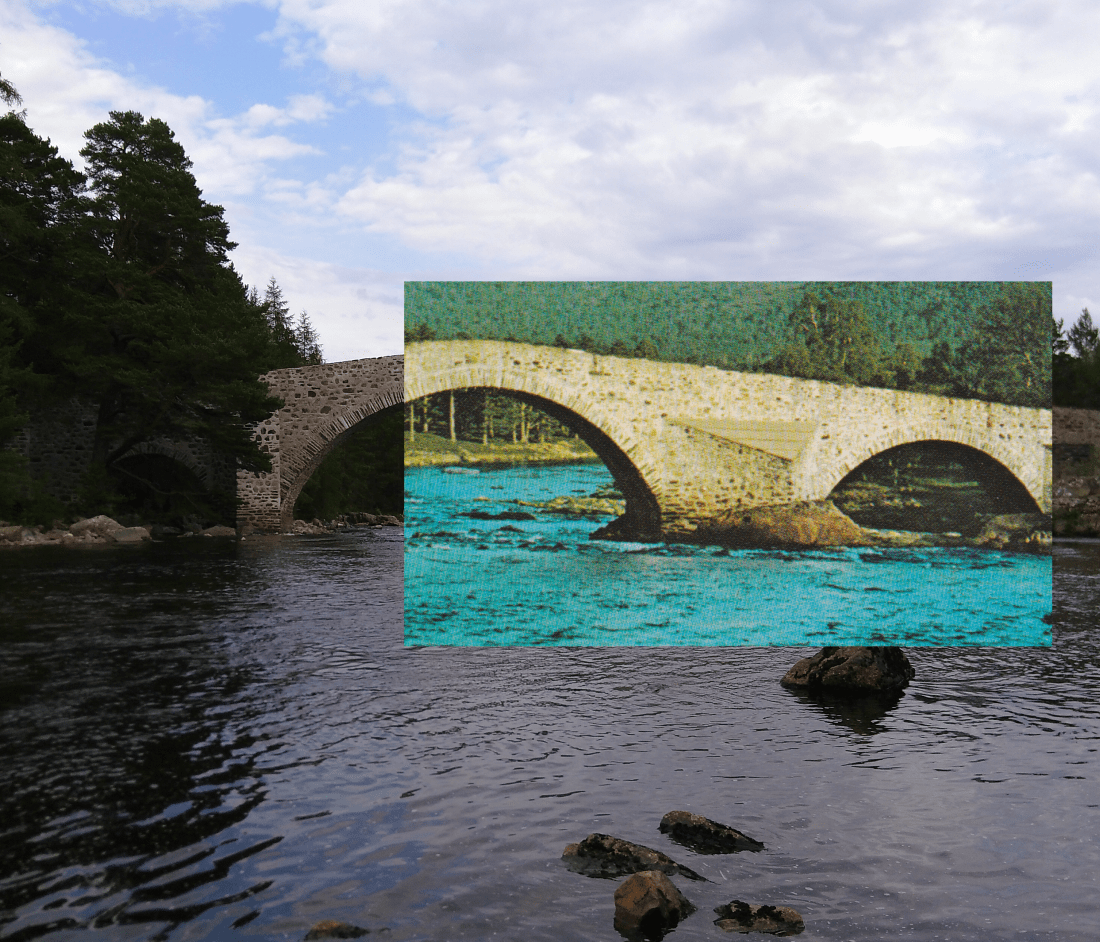
Thankfully, landscapes don’t suffer from anorexia, so impossible depictions of them can hardly be said to be the direct cause of harm. But why go to all the trouble of editing what I imagine was an excellent photo of the subject? Clearly the water was felt to be insufficiently blue to attract potential buyers of the resulting postcard to choose it, rather than a competitor, as being suitably symbolic of their trip to Scotland when writing to their friends and relatives to tell them about it. This seems strange, as it is hardly as though Scotland is famed for the blueness of either its skies or its waters. Indeed, one only visits Scotland for the weather when utterly fed up with sunny days without a cloud in the sky.
So, at worst, this is just the very thin end of some sort of wedge: a photograph of some scenery perceived as needing to be ‘touched up’ because the actual photons captured by a chemical reaction on the negative at the time the photo was taken somehow fail to reflect an image that lives up to our ideal of what we think the world should be like. And our activities to modify the world (rather than photos of it) to make it so do cause harm. Which leaves the question, “What is the fat end of that wedge?”

 The Ecocyborg Manifesto